A bottle of Aquila Vodka sits on a shelf in a small pub in Uthiru, next to a popular pork joint. It retails for Sh160. A few shelves away, Shakers Vodka carries the same price. Klassic Vodka, Blue Mountain, Bob Vodka, Cresent all sell for between Sh140 and Sh160. The same prices hold in Machakos, Kiambu and Ruiru. But according to the Alcoholic Beverages Association of Kenya (ABAK), producing a single 250ml bottle of spirits costs Sh184.81. It doesn’t add up. And when the math does not add up in the alcohol business, people die. Some of the alcohol have copied names of legitimate drinks with the catch being the price. For example, a legitimate Shakers Vodka 750ml bottle retails at a minimum Sh3,000 and it is found mainly in the US.
Former Industrialisation Cabinet Secretary Moses Kuria, under whose docket alcohol manufacturing fell knows too well about fake alcohol and says the maths many brewers are using is not adding up. Citing industry baseline estimates that manufacturing a millilitre of ethanol-based alcohol costs at least Sh1, Kuria argued that the minimum retail price for a 250ml bottle of spirits should be Sh250, “assuming break-even only”. “Any vendor offering a 250ml unit below this floor is likely dealing in tax-evading, uncertified, or dangerous illicit brews,” he stated.
The vendors are everywhere. The products have names. The bottles have labels. And the content, according to government lab tests, are often poison.
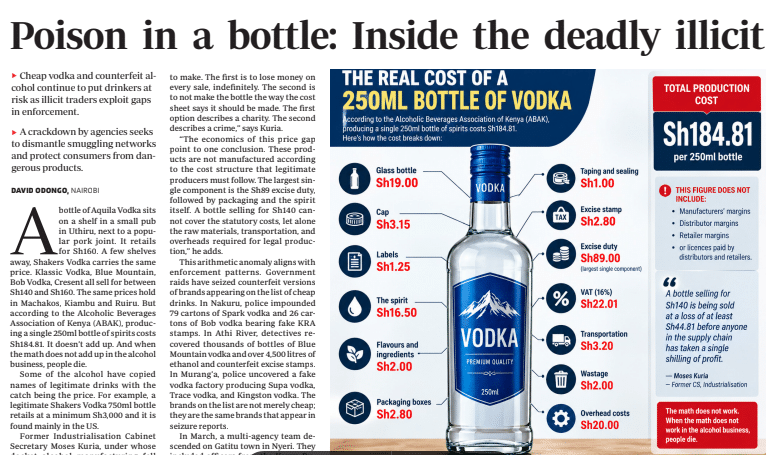
ABAK’s standard costing for a 250ml bottle of spirits breaks down the components any legitimate manufacturer must pay for. The glass bottle costs Sh19. The cap costs Sh3.15. Labels cost Sh1.25. The spirit itself costs Sh16.50. Flavours and ingredients add Sh2. Packaging boxes cost Sh2.80. Taping and sealing add Sh1. Then come government charges. The excise stamp costs Sh2.80. Excise duty costs Sh89. Sub-total: Sh137.60. VAT at 16 per cent adds Sh22.01. Factory cost sub-total: Sh159.61. Transportation adds Sh3.20. Wastage accounts for Sh2. Overhead costs Sh20. Total production cost comes to Sh184.81. This figure, ABAK notes, does not include manufacturers’ margins, distributor margins, retailer margins, or licences paid by distributors and retailers.
“A bottle selling for Sh140 is being sold at a loss of at least Sh44.81 before anyone in the supply chain has taken a single shilling of profit. There are only two ways to sell a bottle for Sh140 when it costs Sh184.81 to make. The first is to lose money on every sale, indefinitely. The second is to not make the bottle the way the cost sheet says it should be made. The first option describes a charity. The second describes a crime,” says Kuria.
“The economics of this price gap point to one conclusion. These products are not manufactured according to the cost structure that legitimate producers must follow. The largest single component is the Sh89 excise duty, followed by packaging and the spirit itself. A bottle selling for Sh140 cannot cover the statutory costs, let alone the raw materials, transportation, and overheads required for legal production,” he adds.
This arithmetic anomaly aligns with enforcement patterns. Government raids have seized counterfeit versions of brands appearing on the list of cheap drinks. In Nakuru, police impounded 79 cartons of Spark vodka and 26 cartons of Bob vodka bearing fake KRA stamps. In Athi River, detectives recovered thousands of bottles of Blue Mountain vodka and over 4,500 litres of ethanol and counterfeit excise stamps. In Murang’a, police uncovered a fake vodka factory producing Supa vodka, Trace vodka, and Kingston vodka. The brands on the list are not merely cheap; they are the same brands that appear in seizure reports.
In March, a multi-agency team descended on Gatitu town in Nyeri. They included officers from the Kenya Bureau of Standards (KEBS), the Anti-Counterfeit Authority (ACA), the Kenya Revenue Authority (KRA), the county public health department, and the Directorate of Criminal Investigations (DCI). Each agency collected samples that were independently tested at the Government Chemist. All five beer brands sampled failed to meet national standards.
ACA found the content did not match what was indicated on labels. The Government Chemist found the beverages contained harmful levels of alcoholic substances “deemed poisonous to the human body”.
Kui Kinyanjui, chair of ABAK, says: “The products were found on the shelves in branded bottles, raising serious concerns about their origin and authenticity. We must ask, who are the manufacturers behind these brands?”
KEBS insists methanol in Kenya cannot be consumed accidentally. In October 2025, it issued a statement reassuring the public that all methanol in the country is “denatured by adding the bitterest chemical called denatonium benzoate”.
KEBS cited standards requiring non-laboratory methanol to contain not less than eight parts per million of the denaturant. “The people dying from methanol poisoning are drinking from bottles branded as vodka, gin, and brandy. The methanol in those bottles, if it came from a denatured source, has either been chemically treated to remove the bitterness, or it came from a source that never passed through KEBS certification at all,” says Doctor Isaac Micheni.